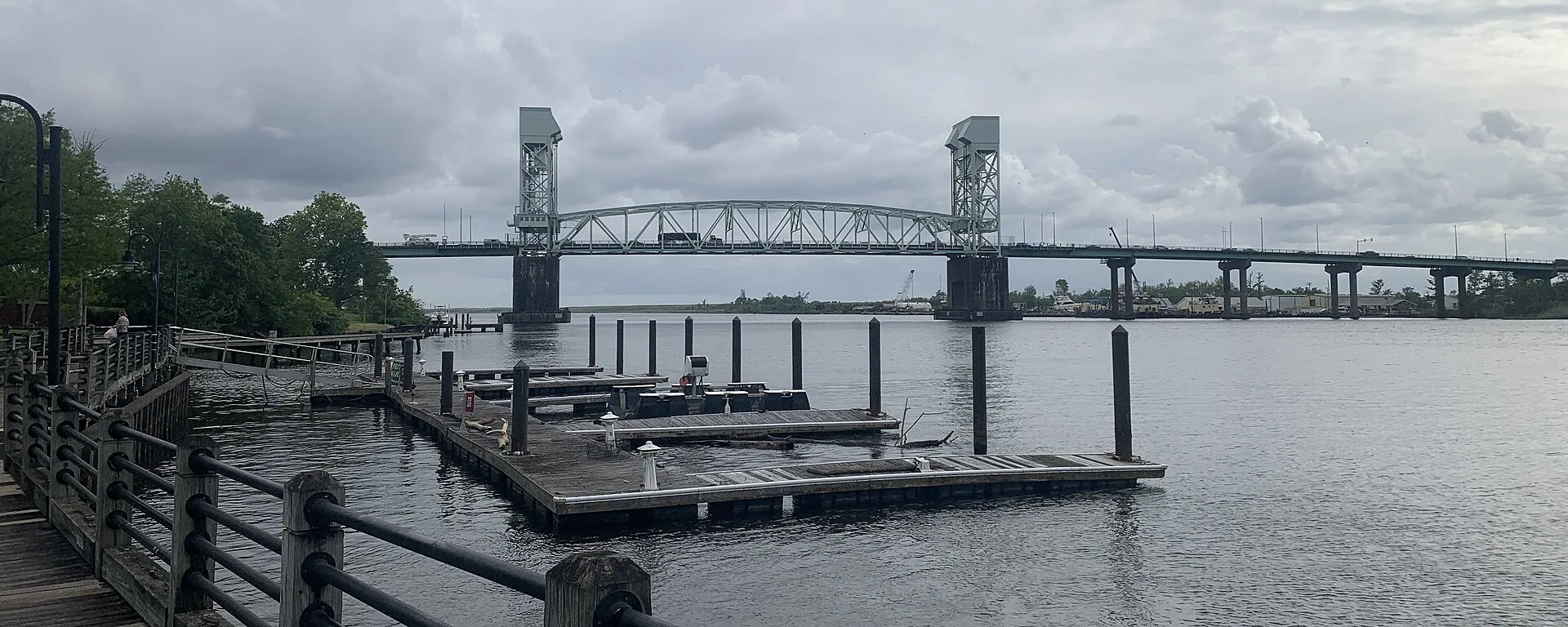
NCDOT's revised fixed-span design drops the Fifth Avenue route and affects 17 parcels, not 63. Comments on the new plan are open through Nov. 30.
The N.C. Department of Transportation has redrawn its fixed-span design for the new Cape Fear Memorial Bridge. The new version would bring bridge traffic into downtown Wilmington at Third Street, not Fifth Avenue.
NCDOT calls it Revised Alternative B. It keeps the 135-foot fixed span but uses a tighter corkscrew ramp on the downtown side. The department says the change cuts the number of affected parcels from 63 to 17.
A new public comment period on the revised design runs through Monday, Nov. 30. The details are on NCDOT’s project comment page.
What changed
The changes are set out in an Environmental Assessment Addendum. NCDOT and the Federal Highway Administration approved it Oct. 30, and NCDOT posted it on its project documents page Nov. 4.
Under the revised design:
- the bridge still has a 135-foot fixed span, so ships pass without stopping traffic
- the ramps on the downtown side tie in to the Dawson Street and Wooster Street one-way pair at Third Street
- the ramp near Queen and Second streets is smaller, and the retaining wall planned there is gone
- the revised design runs south of the existing bridge to avoid Dram Tree Park
- the work across the river at the U.S. 17, U.S. 76 and U.S. 421 interchange is unchanged
The bridge itself is the same in both versions. It would carry three 12-foot lanes each way, 12-foot shoulders and a 15-foot multi-use path on the north side, the addendum says.
Why NCDOT redrew it
NCDOT received 1,802 comments between Aug. 14 and Oct. 15, according to the addendum.
The original Alternative B would have moved the main downtown connection to Fifth Avenue. The addendum says commenters objected to that. They also worried the design would undo the city’s Fifth Avenue work, finished in December 2025, which narrowed the street to one lane each way with parking, bike lanes and sidewalks. Others raised effects on the Wilmington Historic District.
The city raised the same concerns with NCDOT Secretary Daniel Johnson in September, as we reported. NCDOT now says the revised design “addresses many of the comments received from the community.”
The three designs side by side
These figures come from Tables 1, 2 and 4 of the addendum. NCDOT says all cost estimates are preliminary and may change.
| Alternative A (lift span) | Original Alternative B (fixed) | Revised Alternative B (fixed) | |
|---|---|---|---|
| Clearance over the river | 65 to 135 feet | 135 feet | 135 feet |
| Downtown connection | Third Street | Fifth Avenue | Third Street |
| Parcels affected | 22 | 63 | 17 |
| Business relocations | 3 | 2 | 2 |
| Home relocations | 0 | 2 | 0 |
| Permanent right of way | 17.2 acres | 19.5 acres | 30.1 acres |
| Temporary construction easements | 0.3 acres | 6.1 acres | 0.03 acres |
| Estimated cost | $1,110,700,000 | $1,029,800,000 | $1,020,500,000 |
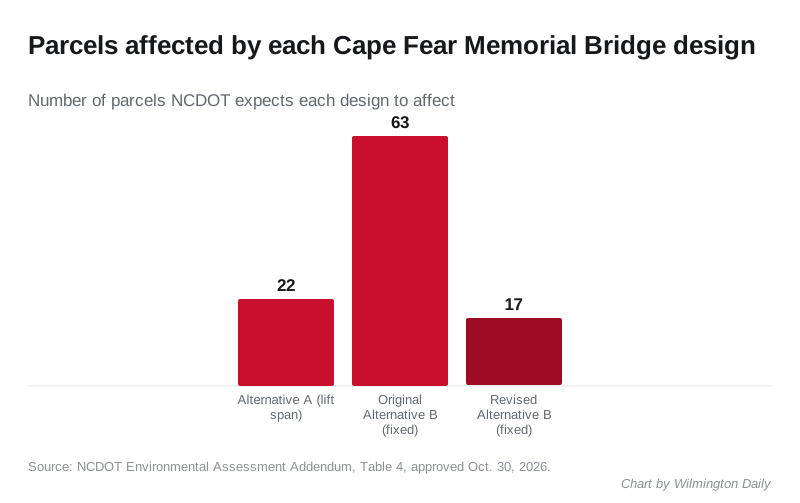
Two points stand out in the table. The revised design needs more permanent right of way than either earlier option, at 30.1 acres. But it touches far fewer parcels and needs almost no temporary construction easements.
The addendum also says:
- the original Alternative B would have affected the Dollar General downtown, and the revised design affects no community resources
- the revised design affects one site of possible soil or water contamination, down from three
- traffic noise is expected to be “generally similar” to Alternative A, and a new noise study will follow
What did not change
The revised design has the same effect on wetlands and the floodplain as the original Alternative B. Both would affect about 10.8 acres of wetlands and 20.8 acres of the 100-year floodplain, the addendum says. Alternative A would affect 1.2 acres of wetlands and 1.4 acres of floodplain.
NCDOT and the state Historic Preservation Office have reached preliminary agreement that any new 135-foot fixed bridge would have an adverse effect on the Historic District’s views. Ways to offset that will be worked out later under a formal agreement, the addendum says.
Tolls
The addendum assumes the revised design would be tolled, for the purpose of measuring its effects. It says it would need money beyond the federal grant and NCDOT funds.
No toll has been decided. Under state law, a toll on the bridge would need approval from the Wilmington Urban Area Metropolitan Planning Organization and the N.C. General Assembly, the addendum says. If a toll were approved, the Isabel Holmes Bridge, about two miles north, would stay free.
What happens next
NCDOT’s project comment page gives this timeline:
- Through Nov. 30: public comment on Revised Alternative B
- Early 2027: a preferred design is chosen
- Early 2027: approval of a finding of no significant impact
- Right-of-way purchases and construction: dates not yet set
NCDOT says future dates may change. The same page also says, in its next-steps text, that a design could be chosen in late 2026. NCDOT will review the comments with local governments and agency partners before it picks one. A summary of all comments will be attached to the final environmental document.
What it means for you
If you want a say on the new design, you have until Monday, Nov. 30:
- Online: the NCDOT comment page has the new map, renderings from the Riverwalk and from Wooster and Dawson streets, and a short survey
- Email: CapeFearMemorialBridge@publicinput.com
- Phone: 984-205-6615, then enter project code 10626 to leave a message
NCDOT says Alternative A has not changed, and comments on it from the first round have already been captured.
For current work on the bridge and Wilmington’s main roads, see our road construction and closures page.
Have your say