Wilmington was incorporated in 1739 and named for the Earl of Wilmington. Its National Register listings, historic districts and museums, with hours.
Last checked Oct. 11, 2026. Facts on this page come from the City of Wilmington’s Community Honors and Historic Districts pages, the National Park Service’s National Register database (May 2026 release), the N.C. State Historic Preservation Office, and each museum’s own site.
Wilmington was incorporated in 1739 and became a city in 1866, according to the City of Wilmington. It was named for Spencer Compton, the Earl of Wilmington, prime minister under King George II. The city’s historic district design standards (PDF) give the incorporation as 1739/40 and date the original street plan to 1733.
Who to call
- City Historic Preservation (local districts, landmark rules): preservation@wilmingtonnc.gov, or city Planning, 910-254-0900
- Lower Cape Fear Historical Society (Latimer House and archive): 126 S. Third St.
- Burgwin-Wright House: 910-762-0570
- Battleship North Carolina: 910-399-9100
A short timeline
| Year | What happened | Source |
|---|---|---|
| 1733 | Original street plan laid out | City design standards |
| 1739 | Incorporated as Wilmington | City of Wilmington |
| 1770 | Burgwin-Wright House built | Burgwin-Wright House |
| 1840 | Wilmington and Raleigh Railroad completed; the city says it was then the largest continuous railroad track in the world, and Wilmington the largest town in North Carolina | City of Wilmington |
| 1852 | Oakdale Cemetery chartered by the General Assembly; Latimer House built | Oakdale Cemetery; Latimer House |
| 1866 | Becomes a city | City of Wilmington |
| 1962 | City Council designates the first local historic district | City of Wilmington |
| 1974 | Wilmington Historic District listed on the National Register | National Park Service |
| 2003 | Named the first Coast Guard City on the East Coast | City of Wilmington |
| 2020 | Named the first World War II Heritage City in the country, Sept. 2 | City of Wilmington |
The historic downtown
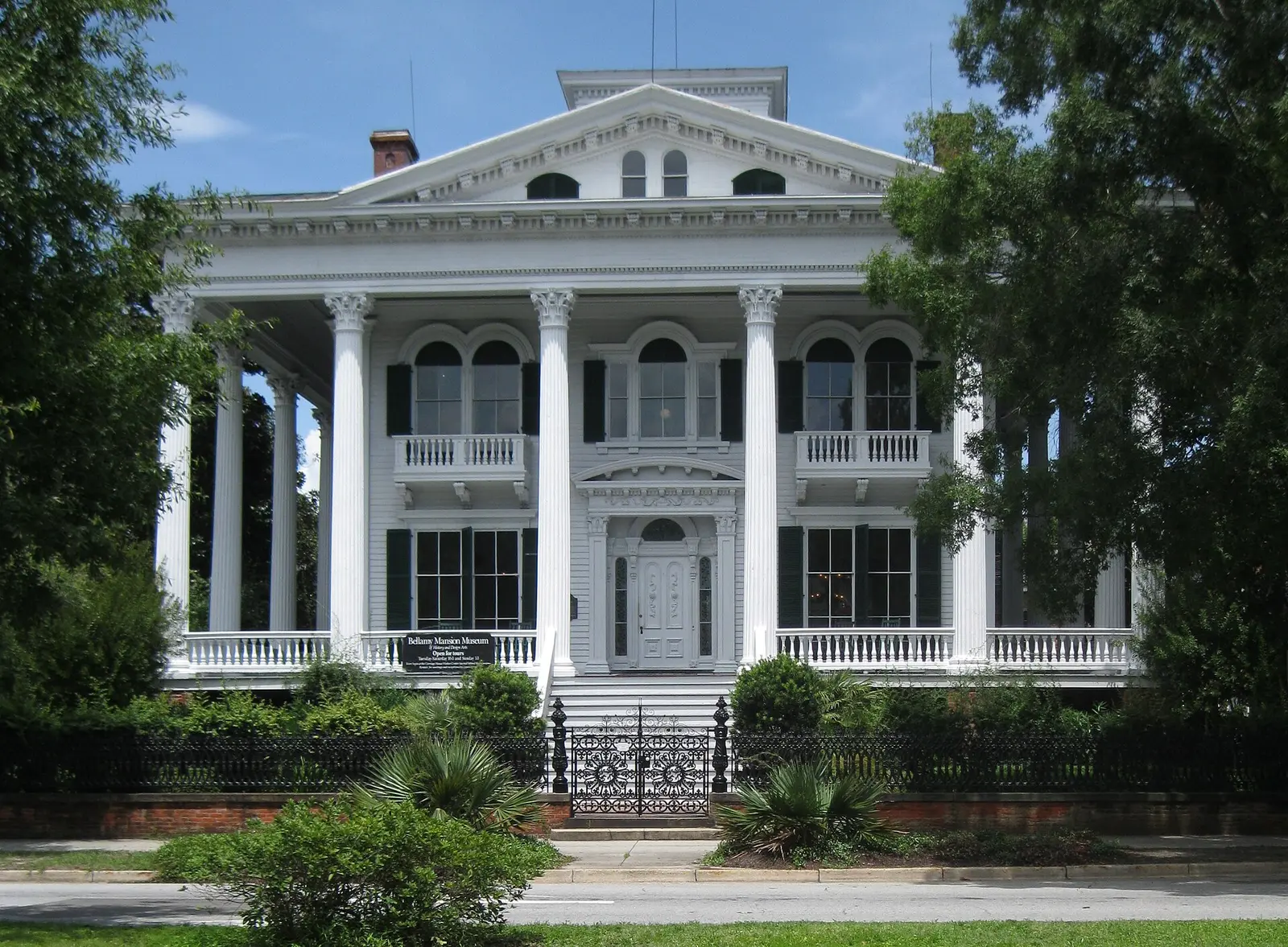
The Wilmington Historic and Archaeological District, listed on the National Register on May 6, 1974, covers the old downtown, roughly from Wright Street to Harnett Street and from the river to Seventh Street. A 2003 boundary increase added more blocks around it. Many of the city’s best-known buildings, including the Bellamy Mansion, the Burgwin-Wright House and the Latimer House, stand inside it.
The city also runs its own local historic districts, where changes to buildings need a Certificate of Appropriateness: the Theater Historic District around Thalian Hall, the Residential and Mixed-Use historic districts, the Downtown Commercial Historic District Overlay, and the Carolina Heights/Winoca Terrace Historic District Overlay, an early 20th-century streetcar suburb. See our permits guide.
Every National Register listing in the city
From the National Park Service’s database, with the date each was listed:
| Listing | Where | Listed |
|---|---|---|
| City Hall/Thalian Hall | 100 N. Third St. | April 3, 1970 |
| Federal Building and Courthouse | North Water Street between Market and Princess streets | May 2, 1974 |
| Wilmington Historic and Archeological District | Downtown | May 6, 1974 |
| Market Street Mansion District | 1704, 1705, 1710 and 1713 Market St. | April 21, 1975 |
| USS North Carolina | Cape Fear River, across from downtown | July 23, 1981; National Historic Landmark listing Nov. 10, 1982 |
| James Walker Nursing School Quarters | 1020 Rankin St. | July 20, 1989 |
| Carolina Place Historic District | Market Street, Wallace Park, Gibson Avenue, Wrightsville Avenue and South 18th Street | Aug. 31, 1992 |
| Audubon Trolley Station | Park Avenue at Audubon Boulevard | Aug. 5, 1993 |
| Wilmington National Cemetery | 2011 Market St. | Jan. 31, 1997 |
| William Hooper School (former) | 410 Meares St. | March 12, 1998 |
| Carolina Heights Historic District | Market, 13th, Rankin and 19th streets | July 29, 1999; enlarged Nov. 30, 1999 |
| Delgado School (spelled Delgrado in the federal database) | 1930 Colwell Ave. | Oct. 20, 2001 |
| Wilmington Historic District boundary increase | Downtown and nearby blocks | May 1, 2003 |
| Sunset Park Historic District | Carolina Beach Road, Southern Boulevard, Burnett Boulevard and Sunset Avenue | Dec. 10, 2003 |
| Gabriel’s Landing | 1005 Airlie Road | May 7, 2008 |
| Westbrook-Ardmore Historic District | Dock Street, Wrightsville Avenue, Queen and Lingo streets, South 14th Street | Feb. 5, 2009 |
| Brookwood Historic District | Market Street, Keaton Avenue, Burnt Mill Creek and Wallace Park | Dec. 2, 2014 |
The city also counts the Masonboro Sound Historic District, just outside the city, among its National Register districts. Elsewhere in New Hanover County, the register includes Fort Fisher, about 18 miles south on U.S. 421 (Oct. 15, 1966), and Mount Lebanon Chapel and Cemetery near Airlie (Oct. 16, 1986). Each listing’s nomination, with its history and photographs, is linked from the State Historic Preservation Office’s list.
Museums and historic sites you can visit
| Site | Address | Hours, as each site publishes them |
|---|---|---|
| Burgwin-Wright House and Gardens | 224 Market St. | 10 a.m. to 4 p.m. Monday through Saturday; guided tours on the hour, last at 3 p.m. |
| Bellamy Mansion Museum | 503 Market St. | 10 a.m. to 4 p.m. daily; self-guided tours must start by 4 p.m. |
| Latimer House (Lower Cape Fear Historical Society) | 126 S. Third St. | Guided tours at 10 and 11 a.m., noon, 1 and 2 p.m. |
| Cape Fear Museum | 230 Grace St. | 9 a.m. to 5 p.m. Monday through Saturday; 1 to 5 p.m. Sunday |
| Wilmington Railroad Museum | 505 Nutt St. | Labor Day to Memorial Day: 10 a.m. to 4 p.m. Monday through Saturday, closed Sunday |
| Battleship North Carolina | 1 Battleship Road | 8 a.m. to 5 p.m. daily |
| Oakdale Cemetery | 520 N. 15th St. | Grounds 8 a.m. to 5 p.m. every day; office 9 a.m. to 4 p.m. |
The Burgwin-Wright House, built in 1770 on the ballast-stone walls of the town’s former jail of about 1744, calls itself the only colonial-era building in Wilmington open to the public. Oakdale Cemetery, chartered in 1852, was the first rural-style cemetery in North Carolina, according to the cemetery. The Latimer House, built in 1852, holds the Lower Cape Fear Historical Society’s Ida B. Kellam Memorial Archive, which helps with genealogy and research.
Holiday closings vary; check each site before you go. Seasonal tours, including the Latimer House’s night tours on the first and third Saturdays and the Burgwin-Wright House’s fall events, are on their sites and on our things to do this month page.
Historical markers
North Carolina’s Highway Historical Marker program has placed markers across the city, including one for the Wilmington Morning Star, now the StarNews, which the marker says was established Sept. 23, 1867. The city also has 1898 Memorial Park at 1018 N. Third St.
Frequently asked questions
When was Wilmington, NC founded? Wilmington was incorporated in 1739 and became a city in 1866, according to the City of Wilmington. The city’s historic district standards date its original street plan to 1733.
Who is Wilmington, NC named after? Spencer Compton, the Earl of Wilmington, who was prime minister under King George II.
What is the oldest house in Wilmington open to the public? The Burgwin-Wright House at 224 Market St., built in 1770, is the only colonial-era building in Wilmington open to the public, according to the museum. It is open 10 a.m. to 4 p.m. Monday through Saturday.
How many National Register historic districts are in Wilmington? The city lists eight: Wilmington Historic and Archaeological, Market Street Mansion, Carolina Place, Carolina Heights, Masonboro Sound, Sunset Park, Westbrook-Ardmore and Brookwood.
Why is Wilmington called a World War II Heritage City? On Sept. 2, 2020, Wilmington was named the first World War II Heritage City in the country, the city says.
More: parks and trails, things to do this month and population and growth.
Have your say