Wilmington City Council votes Tuesday, Dec. 1, on formal comments asking NCDOT for a full environmental impact statement on the Memorial Bridge redesign. Comments close Dec. 4.
Wilmington City Council will vote Tuesday, Dec. 1, on the city’s formal response to the revised Cape Fear Memorial Bridge design. The response asks the N.C. Department of Transportation to consider a full Environmental Impact Statement, the most detailed federal review, before it picks a design.
The resolution is item R3 on the council’s Dec. 1 agenda. The meeting starts at 6:30 p.m. at City Hall’s Skyline Center, 929 N. Front St. If council approves it, the city will send the resolution and a staff report to NCDOT as its formal comments. Public comments on the redesign close Friday, Dec. 4.
What the city will ask for
The resolution makes 10 requests of NCDOT. The main ones:
- Revisit the review. Reconsider whether an Environmental Impact Statement is needed, and give the public another chance to comment once the missing studies are done.
- No design choice yet. Finish the traffic, economic, environmental and historic studies before a preferred design is named.
- Look at cheaper options, including the city’s own designs.
- Recheck the river. Review how much clearance and channel width ships need, with the city, the U.S. Army Corps of Engineers and the U.S. Coast Guard.
- No tolls on any replacement bridge.
- Written answers. NCDOT should answer each of the city’s questions in writing.
These comments add to the ones the city sent in October. They do not replace them, the resolution says.
Why the city says a fuller study is needed
NCDOT’s revised fixed-span design, Revised Alternative B, brings traffic into downtown on a large looping ramp at Third Street. The city’s staff comments argue that the loop puts a road on a new alignment, away from the existing bridge.
Federal rules say a highway project with “four or more lanes on a new location” normally needs an Environmental Impact Statement, the staff comments note. The city contends the loop meets that test.
NCDOT has so far described the project as heading toward a Finding of No Significant Impact, which would end the review without that fuller study. The city counts eight places in NCDOT’s 30-page addendum that say this finding is expected. It says the expected outcome is stated before key studies are finished.
The city’s other concerns
The staff comments raise these points about the revised design:
- Port trucks at a signal. Port-bound drivers now use a slip ramp to South Front Street where they only yield. Under the revised design they would turn left at a traffic signal. The city says that could back traffic up onto the ramp.
- Historic buildings. Three buildings near the new ramp have turned 50 since the downtown historic district was listed. They are Solomon Towers at 15 Castle St., the Jacobi-Lewis Company building at 622 S. Front St. and the former Jacobi Hardware Company building at 723 Surry St. The city says each needs a fresh historic review.
- What may be buried. The ramp would sit on old riverfront industrial land. In 1924, workers found a 20-foot Civil War-era freight boat buried under what is now Dram Tree Park, the city notes. It wants a full archaeological survey on land before a design is chosen.
- The bike and walking path. The city asks how cyclists and walkers would manage the spiral ramp’s slope and curves.
- Noise. NCDOT’s addendum lists fewer than 102 homes and other places affected by noise under the revised design, but without a new noise study behind the figure, the city says.
- Comments. NCDOT received 1,802 comments on the original assessment but published only summaries, the city says. It wants the full set made public.
On tolls, the staff comments cite NCDOT’s own estimate that tolling would shift 43% of current traffic to the Isabel Stellings Holmes Bridge by 2030. The city says NCDOT has not studied what that would do to downtown streets and businesses.
The city’s cheaper design
The city wants NCDOT to study its own plan, City Design Alternative 2, alongside NCDOT’s. It would work like this, according to the staff comments:
- The existing bridge would carry westbound traffic and a path for walkers and cyclists.
- A second lift bridge, built to the south, would carry eastbound traffic.
- Together they would carry six lanes and meet today’s shipping clearance rules.
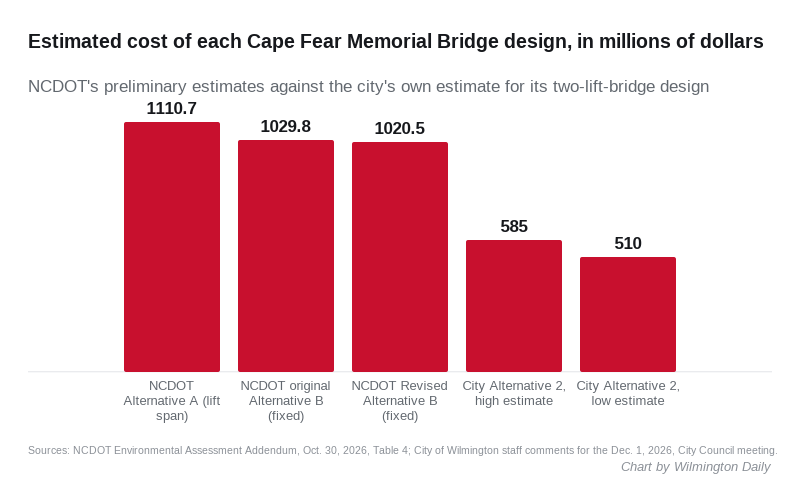
The city estimates it would cost $510 million to $585 million. NCDOT’s preliminary estimates for its three designs run from about $1.02 billion to $1.11 billion, according to Table 4 of its Environmental Assessment Addendum:
| Design | Estimated cost |
|---|---|
| NCDOT Alternative A (lift span) | $1,110,700,000 |
| NCDOT original Alternative B (fixed span) | $1,029,800,000 |
| NCDOT Revised Alternative B (fixed span) | $1,020,500,000 |
| City Design Alternative 2 (two lift bridges) | $510 million to $585 million |
The city says its design would stay cheaper for the state even if the project lost its $242 million federal grant over timing.
The city also asks NCDOT to consider a five-lane bridge, with two lanes into downtown and three out. The extra outbound lane would help in a hurricane evacuation, the city says, while limiting traffic entering downtown neighborhoods.
What happens next
NCDOT’s comment page says its team will review all comments after Dec. 4 and post a summary. Its timeline puts the choice of a preferred design in early 2027. Our story on the revised design has NCDOT’s full comparison of the options.
What it means for you
- Watch the meeting: 6:30 p.m. Tuesday, Dec. 1, at City Hall’s Skyline Center, 929 N. Front St.
- Comment to NCDOT yourself by Friday, Dec. 4, on its comment page, by email to CapeFearMemorialBridge@publicinput.com or by phone at 984-205-6615, project code 10626.
- Nothing changes on the bridge yet. No design, toll or construction date has been decided.
Have your say